How to Improve a Loksewa Written Answer in 5 Minutes
Use this five-minute Loksewa answer review to improve structure, relevance, examples, language and time control before you move on.
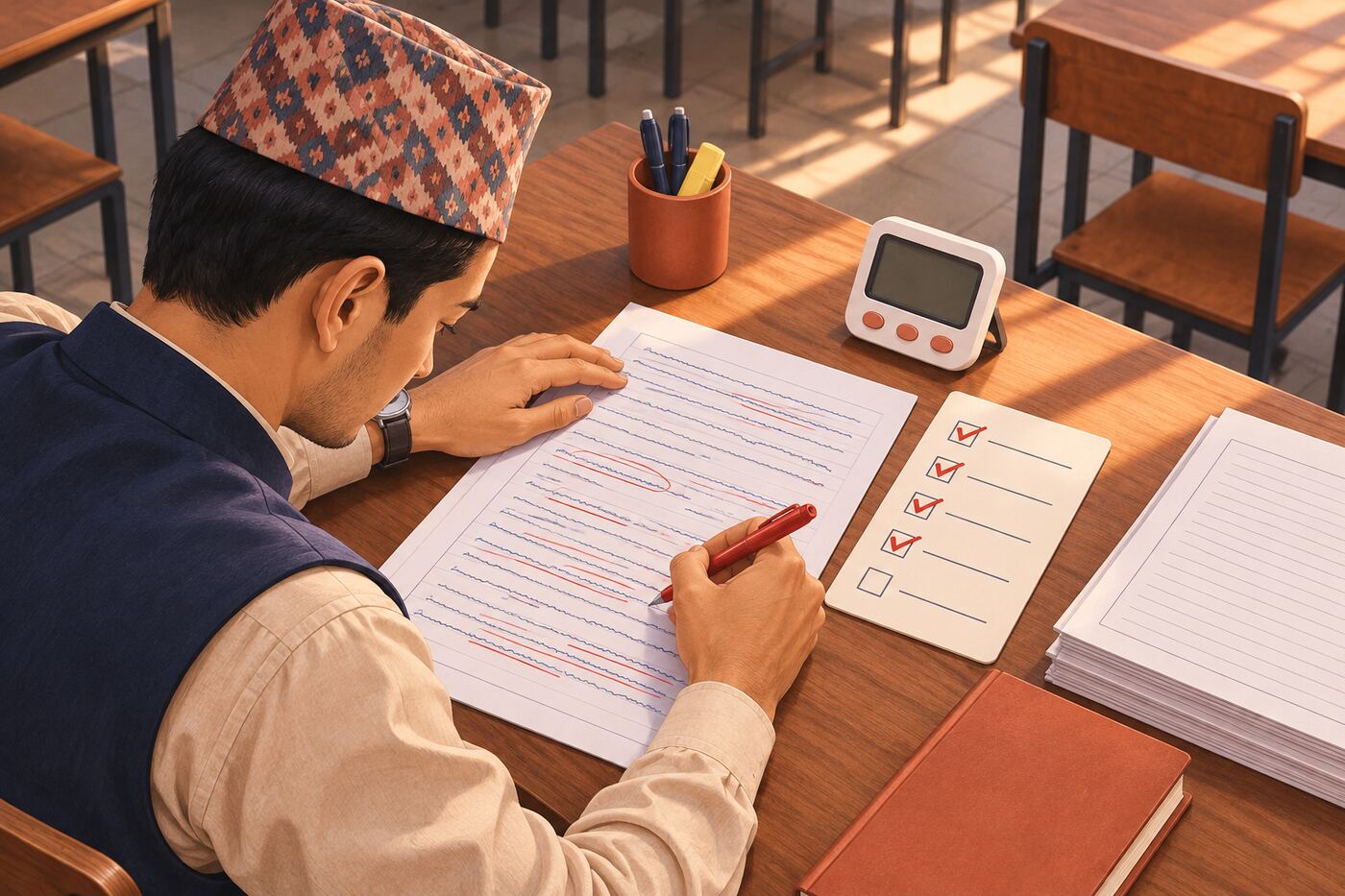
What should you check after writing a Loksewa answer?
Do not put the pen down the moment you finish. A short five-minute review can improve an answer more than adding one rushed paragraph. It helps you catch the common problems that cost marks: a missed command word, an unclear opening, unsupported points or a conclusion that simply repeats the question.
Begin with the official syllabus and command word
Use the Public Service Commission syllabus section to keep your practice tied to the post and paper you are preparing for. Before reviewing an answer, circle the command word in the question: explain, analyse, compare, discuss, evaluate or suggest. Your answer should visibly do that job, not merely show that you know the topic.
Check the first two lines
Read only your opening. Does it answer the question directly and define the focus in plain language? A useful opening tells the examiner where the answer is going. If your first lines are broad background with no connection to the question, replace them with one clear claim or definition.
Make each paragraph earn its place
Give each paragraph one main point. Then check whether the next sentence explains it, gives an example or shows an effect. If two paragraphs make the same point, combine them. If a paragraph is only a heading followed by vague words, add a concrete detail or remove it.
Add one relevant Nepal context
For many Loksewa answers, a well-chosen Nepal context makes the response more grounded. It could be a public-service situation, a policy implementation challenge, a local-government example or a current institutional responsibility. Use only an example you can explain accurately; an invented statistic weakens a good answer.
Check balance and conclusion
If the question asks for both benefits and challenges, make sure both appear. If it asks for causes and measures, do not spend all your space on causes. End with a brief forward-looking conclusion or practical way forward, not a new unrelated argument.
Do a fast language sweep
Look for repeated words, unfinished sentences, unclear pronouns and headings that do not match the content. Underline the key terms that show you answered the question. Neat spacing and numbered points can help readability, but they cannot replace an organised argument.
Five-minute answer review checklist
- Command word answered directly.
- Opening states the focus.
- Every paragraph has one clear point.
- One accurate, relevant example included.
- Conclusion matches the demand of the question.
Use this same review after every practice answer. Over time, the checklist becomes a habit you can use even under examination pressure.